
 ไทย
ไทย English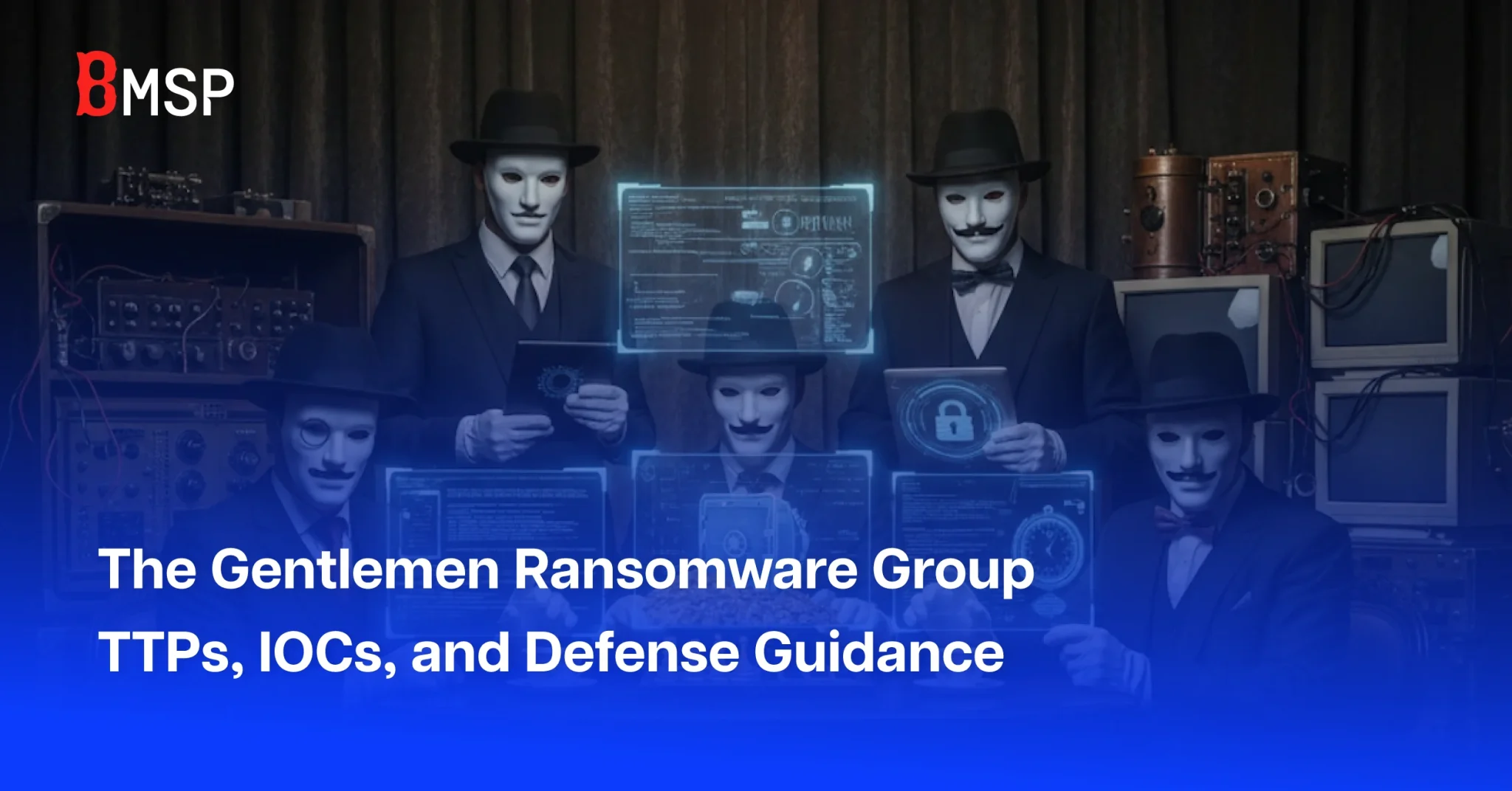

Overview
Based on CloudSEK’s threat intelligence report, “Threat Actor Profile and IOC Reference: The Gentlemen Ransomware Group” this article summarizes the key findings around The Gentlemen ransomware group.
The Gentlemen is a ransomware group focused on targeted, high-impact attacks against organizations where disruption can cause serious operational and financial damage. Based on the analyzed threat intelligence report, the group is linked to custom ransomware payloads, anti-defense tools, privilege escalation utilities, and living-off-the-land techniques that help them move through networks while avoiding detection.
Their known targeting includes healthcare, insurance, manufacturing, construction, and critical infrastructure organizations across the United States, Asia-Pacific, including Thailand, and EMEA. The group appears financially motivated and uses ransomware encryption, data exfiltration, backup disruption, and anti-forensic cleanup as part of its attack chain.
Table of Contents
Who are the Gentlemen?
The Gentlemen is assessed as a cybercriminal ransomware group with above-average operational maturity. Unlike some ransomware-as-a-service groups, there is currently no clear evidence that The Gentlemen operates through a public affiliate model.
The group uses a combination of custom malware and legitimate administrative tools. This makes detection more difficult because some of the tools they abuse, such as PsExec, PuTTY, WinSCP, and AnyDesk, may already exist in normal enterprise environments. Their operations also show a strong focus on disabling defenses before ransomware deployment.
Known aliases include:
- The Gentlemen
- Gentlemen
- TheGentlemen
- Win64.GENTLEMAN.THHAIBE
The report notes that attribution is supported by public research, file detection names, and OSINT, but there is no current Malpedia profile or broad vendor alignment for this actor.
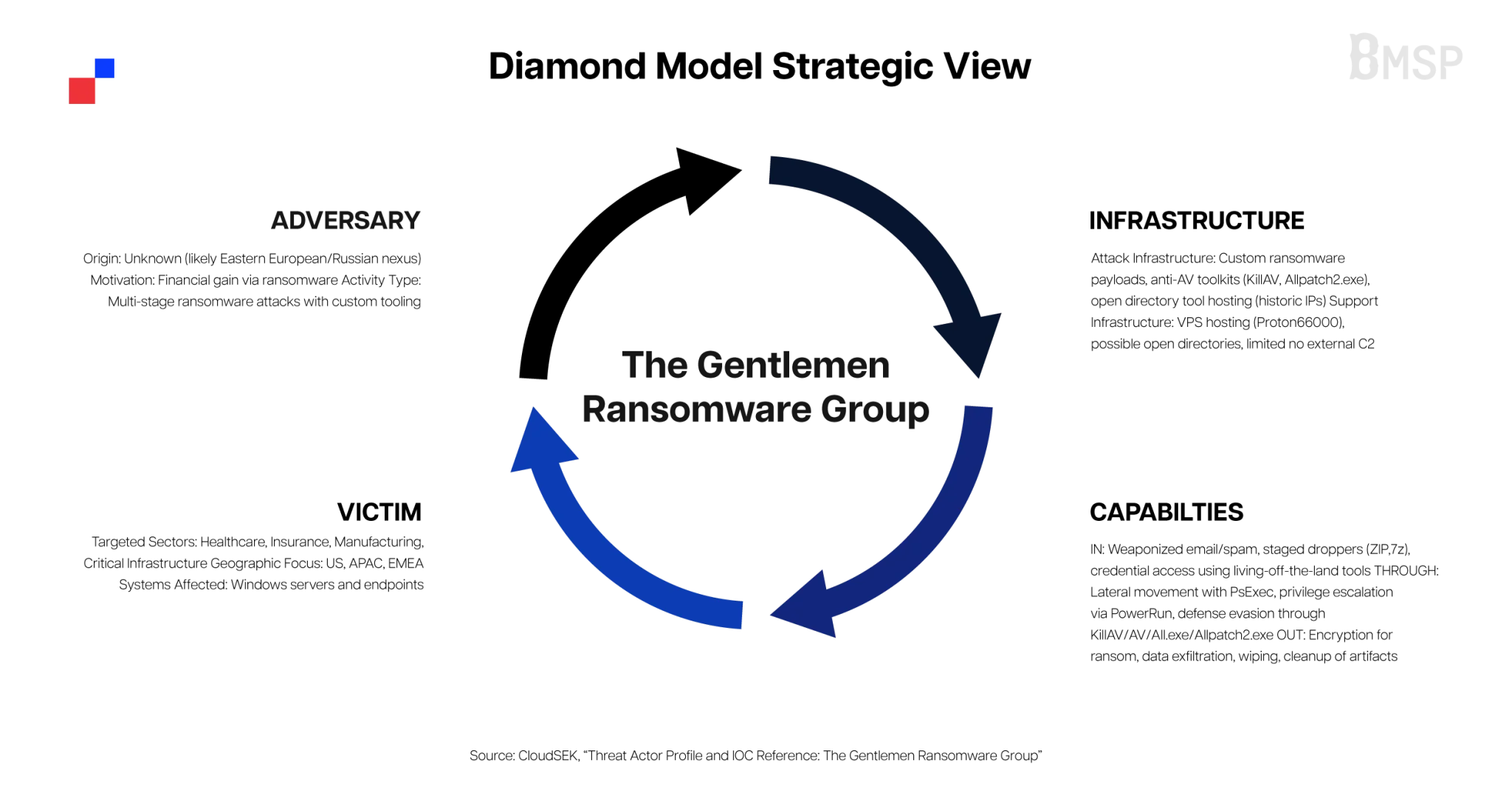
Strategic View: Diamond Model
The diagram on page 4 presents The Gentlemen’s operational model using the Diamond Model framework. It connects four major elements: adversary, victim, capability, and infrastructure.
In simple terms:
- The adversary is a financially motivated ransomware group with an unknown origin, possibly linked to an Eastern European or Russian-speaking ecosystem.
- The victims are mainly organizations in sectors where downtime is expensive and pressure to restore operations is high.
- The capabilities include phishing, staged archive droppers, credential theft, lateral movement, privilege escalation, security tool termination, encryption, exfiltration, and cleanup.
The infrastructure is less visible than many ransomware groups. The report states that no live command-and-control domains or IPs were confirmed as of May 2026, with only one historic community-reported IP address: 176.120.22.127. This suggests the group may rely on temporary hosting, open directories, tool staging, or bring-your-own infrastructure during attacks.
Targeting and Victimology
The Gentlemen appears to prioritize organizations with high operational disruption potential. These include:
- Healthcare
- Insurance
- Manufacturing
- Construction
- Critical infrastructure
The group has shown geographic activity across the United States, Asia-Pacific, especially Thailand, and EMEA. The report mentions targeting across up to 17 EMEA/APAC countries.
This targeting pattern is typical for ransomware actors that want maximum leverage. Healthcare and critical infrastructure organizations often face pressure to restore systems quickly. Manufacturing and construction firms may suffer direct revenue loss from downtime. Insurance organizations may hold sensitive customer and financial data, increasing extortion pressure.
Tactics, Techniques, and Procedures (TTPs)
Attack Lifecycle
The Gentlemen’s attacks can be understood in three major phases: initial access, internal expansion, and final impact.
1. Initial Access
The group has been observed using weaponized emails, supply chain compromise, staged archive droppers such as ZIP and 7z files, and credential theft. These methods allow attackers to gain the first foothold inside a victim environment.
2. Lateral Movement and Defense Evasion
Once inside, The Gentlemen moves quickly across the network. The group uses tools such as PsExec and PuTTY for lateral movement, PowerRun for privilege escalation, and KillAV, All.exe, or Allpatch2.exe to disable security services.
This stage is especially dangerous because attackers may use legitimate administration tools. Security teams should not only look for malware, but also suspicious behavior from trusted tools.
3. Impact and Exfiltration
In the final stage, The Gentlemen encrypts systems, disrupts backups, exfiltrates selected data, and removes traces of activity. The report notes the use of WinSCP for data movement and possible deployment through domain Group Policy Objects.
The group also appears to perform artifact cleanup and registry obfuscation before ransom note deployment. This suggests a short but intense dwell time, where the attacker moves fast after gaining sufficient privileges.
Key MITRE ATT&CK Techniques
The report maps The Gentlemen’s behavior to several MITRE ATT&CK techniques, including:
| Technique ID | Technique | Relevance |
|---|---|---|
| T1055 | Process Injection / Spawning | Used to execute or hide malicious activity inside processes |
| T1036 | Masquerading | Malicious files may appear legitimate |
| T1057 | Process Discovery | Used to understand running services and defenses |
| T1070.004 | File Deletion | Used for cleanup and anti-forensics |
| T1083 | File and Directory Discovery | Used to identify valuable data and systems |
| T1518.001 | Security Software Discovery | Used to identify AV/EDR products |
| T1497 | Virtualization / Sandbox Evasion | Helps malware avoid analysis environments |
| T1071 | Application Layer Protocol | Possible DNS fallback behavior |
| T1082 | System Information Discovery | Used to profile compromised hosts |
These techniques show that The Gentlemen is not just relying on ransomware execution. Their operation includes reconnaissance, privilege escalation, defense evasion, movement across the network, and cleanup.
Indicators of Compromise
The report provides several file-based indicators, especially SHA256 and SHA1 hashes associated with ransomware samples and support tools. These should be added to EDR, SIEM, email gateway, and malware detection platforms where appropriate.
Examples of high-priority SHA256 indicators include:
1848fa2af5371d00bc4f0346ae1f5afd843677ca87de377a3f7b2433c0b7b187
e0ba5641d4ebc6292c44b817c7cc0f74aa8fcf416006bbe27b194d2cc773bef5
f4ae346deaf87fffdbba0086a29c00819df99cfb380bd08f1da60e45e76b1b63
eb3bc08e16d1e7c048aef7ffe3298186f452ce57c6301463d9cdab55af2b4f83
The report also lists one historic infrastructure indicator:
176.120.22.127
However, this IP is described as low-confidence, community-attributed, and useful mainly for retroactive hunting rather than active blocking. No live C2 domains or active malicious domains were confirmed in the report.
Behavioral Indicators
Because The Gentlemen may avoid stable command-and-control infrastructure, behavioral detection is critical.
Important behaviors to monitor include:
- Rapid file creation and deletion in APPDATA or TEMP
- Use of PowerRun.exe followed by multiple process spawns
- Execution of KillAV.exe, All.exe, or Allpatch2.exe
- Service termination commands
- Suspicious AnyDesk registry persistence
- Abnormal use of PsExec, PuTTY, and WinSCP
- Burst DNS activity without clear external C2
- Possible DNS connection to 162.159.36.2:53
The report also identifies mutex values such as:
\BaseNamedObjects\Local\SM0:1680:304:WilStaging_02
\BaseNamedObjects\Local\SM0:1680:120:WilError_03
These can help incident responders identify related activity during host-level analysis.
Detection Recommendations
Security teams should combine hash-based detection with behavioral analytics. Hashes are useful, but attackers can recompile or rename tools. Behavioral detection is more resilient.
Recommended detection areas include:
PowerRun Abuse
Monitor PowerRun.exe when it creates multiple child processes or executes under unusual user contexts. This may indicate privilege escalation.
Security Tool Termination
Alert when tools such as KillAV.exe, All.exe, or Allpatch2.exe attempt to stop services, disable protection, or modify security configurations.
AppData and Temp File Bursts
Mass file creation or deletion in temporary directories can indicate staging, unpacking, encryption preparation, or cleanup activity.
Suspicious Remote Admin Tool Usage
PsExec, PuTTY, AnyDesk, and WinSCP should be monitored closely, especially when used outside normal IT administration patterns.
Registry Persistence
AnyDesk or similar remote access tools appearing in Run keys or persistence-related registry paths should be investigated.
Defensive Priorities
Organizations concerned about The Gentlemen should focus on practical controls that reduce ransomware impact.
First, block and alert on known malicious hashes from the report. These should be deployed across EDR, antivirus, SIEM, and email security tools.
Second, strengthen credential hygiene. The Gentlemen relies heavily on privilege escalation and lateral movement, so domain administrator accounts, service accounts, and remote access credentials should be audited.
Third, harden backup systems. Backup services should be protected from unauthorized service termination, deletion, or privilege changes.
Fourth, monitor legitimate admin tools. Tools like PsExec and WinSCP are not malicious by default, but abnormal use can indicate attacker activity.
Fifth, improve segmentation. Limiting lateral movement can prevent one compromised machine from becoming a full-domain ransomware incident.
Finally, tune detection logic to the local environment. The report warns that thresholds should be adjusted to avoid false positives from legitimate IT activity.
Key Takeaways
The Gentlemen is a financially motivated ransomware group with a strong focus on defense evasion, privilege escalation, and rapid operational impact.
Their lack of confirmed active C2 infrastructure makes traditional network-blocking less effective. Defenders should prioritize endpoint telemetry, process behavior, credential monitoring, registry analysis, and backup protection.
For security teams, the most important lesson is clear: do not rely only on static indicators. The Gentlemen’s use of legitimate tools means behavior-based detection is essential.
Contact BMSP to discuss practical approaches to Threat Detection, Incident Response, and Security Monitoring for your organization.
References
- Threat Actor Profile and IOC Reference: The Gentlemen Ransomware Group. 2026.
- Ransomware – The Gentlemen.
- Gentlemen ransomware samples.
- com. Russian server exposes TheGentlemen ransomware toolkit.
- Community and vendor verdicts for related hash submissions.
- JoeSandbox, Trend Micro, and Check Point family and TTP research, April 2026.