
 ไทย
ไทย English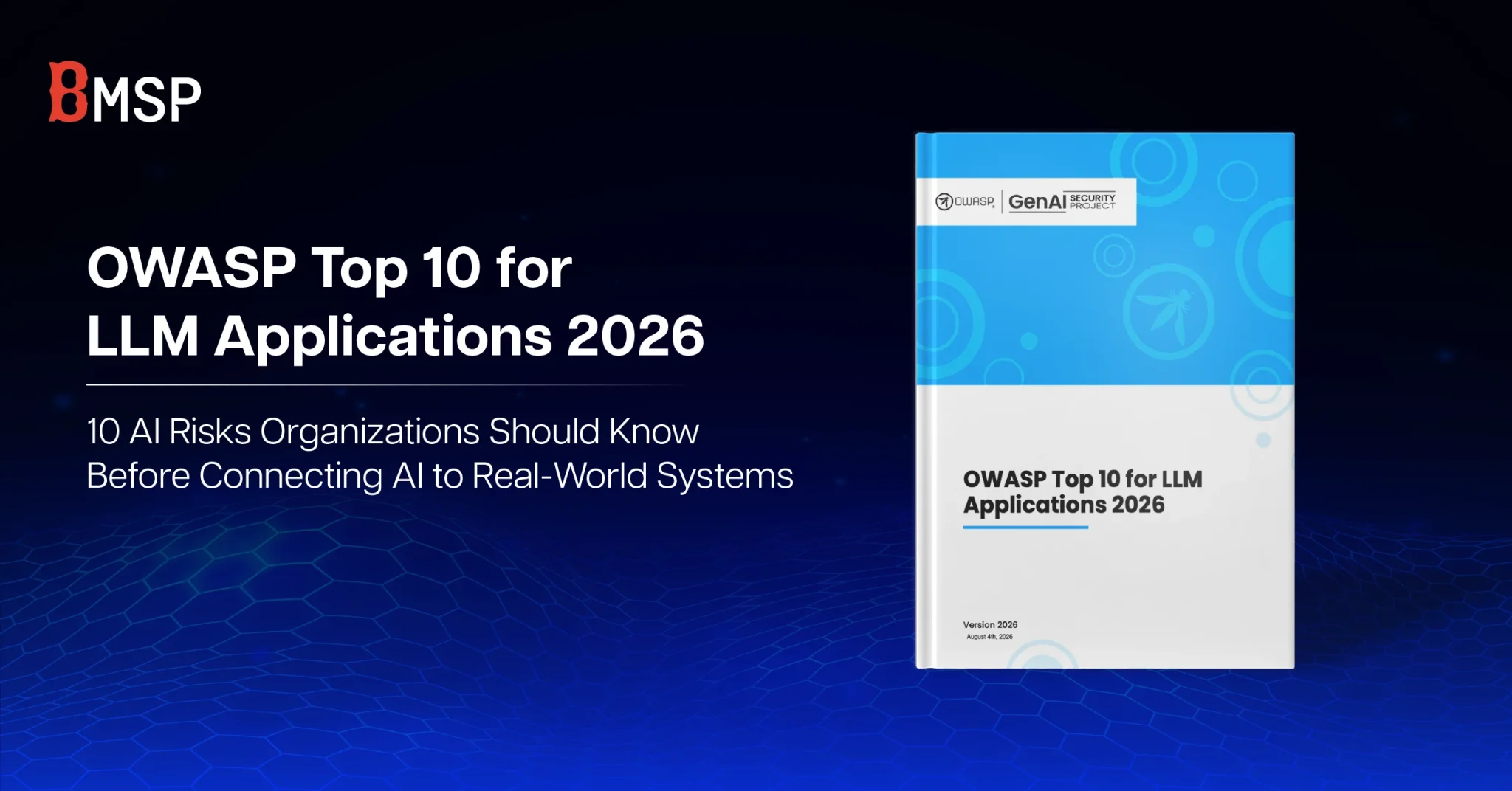

Generative AI is evolving from a tool that simply assists with answering questions into a system capable of performing increasingly complex tasks, including searching internal corporate documents, analyzing data, writing code, connecting to Cloud services, calling APIs, and performing tasks automatically through AI Agents.
These growing capabilities enable organizations to work faster. However, they also expand the Attack Surface, because once AI can access real-world data and systems, errors may no longer result only in incorrect answers. They can lead to data leakage, excessive privilege use, unauthorized actions, or even uncontrolled increases in AI-related costs.
To help organizations better understand and address these risks, OWASP, a global nonprofit organization that develops knowledge and best practices in Application Security and Cybersecurity together with a worldwide expert community, has published the OWASP Top 10 for LLM Applications 2026 through the OWASP GenAI Security Project. The framework identifies 10 major risks that organizations and Security teams should consider when deploying LLMs in real-world environments.
Table of Contents
Key Takeaways
- Prompt Injection remains the number one risk, and malicious instructions do not have to come directly from users. They can be hidden in websites, documents, emails, images, audio, Tool Output, or data retrieved through RAG and presented to the AI.
- AI permissions are just as important as AI capabilities. The more data and Tools an AI can access, the greater the potential damage if it is manipulated or performs an unintended action.
- Sensitive information can leak through more than just AI responses. It may also exist in Prompts, Logs, Traces, Tool Calls, RAG systems, Memory, Embeddings, and Vector Databases.
- Do not use the System Prompt as a Security Boundary. Passwords, API Keys, Authorization Rules, and important Security Policies should be controlled by external systems.
- A confident answer does not necessarily mean a correct answer, especially when the information is used to make decisions or trigger actions in real-world systems.
- Cost Control has become a Security Control. AI systems should implement Token Limits, Spending Caps, Time Limits, and Step Limits to prevent excessive resource consumption.
What is an LLM?
LLM, or Large Language Model, is an AI model trained on large amounts of data to understand and generate human-like language. It can be used to answer questions, summarize documents, analyze information, create content, or assist with writing code.
However, enterprise LLMs today are no longer limited to Chatbots. Many systems are beginning to connect AI with RAG, databases, Email, Cloud platforms, APIs, and internal corporate tools. They are also evolving into AI Agents capable of selecting Tools and executing multi-step workflows independently. As a result, AI Security is becoming a direct part of Cybersecurity, because protection is no longer limited to the model itself. It also includes Identity, Data, Applications, Infrastructure, and every system connected to the AI.
What’s New in the OWASP Top 10 for 2026?
One of the major changes in the 2026 edition is that OWASP no longer determines rankings based solely on expert opinions. It has also incorporated data from real-world incidents.
OWASP collected a total of 7,714 incidents from public vulnerability databases and databases related to AI incidents, with 6,639 incidents containing sufficient information for categorization.
The final ranking was therefore based on:
- 75% expert and community voting
- 25% evidence from real-world incidents
In addition, OWASP has expanded several categories to better reflect how AI is used today, including Prompt Injection through images and audio, risks associated with AI Agents, Model Supply Chain, RAG, Embeddings, and insecure code generated by AI.
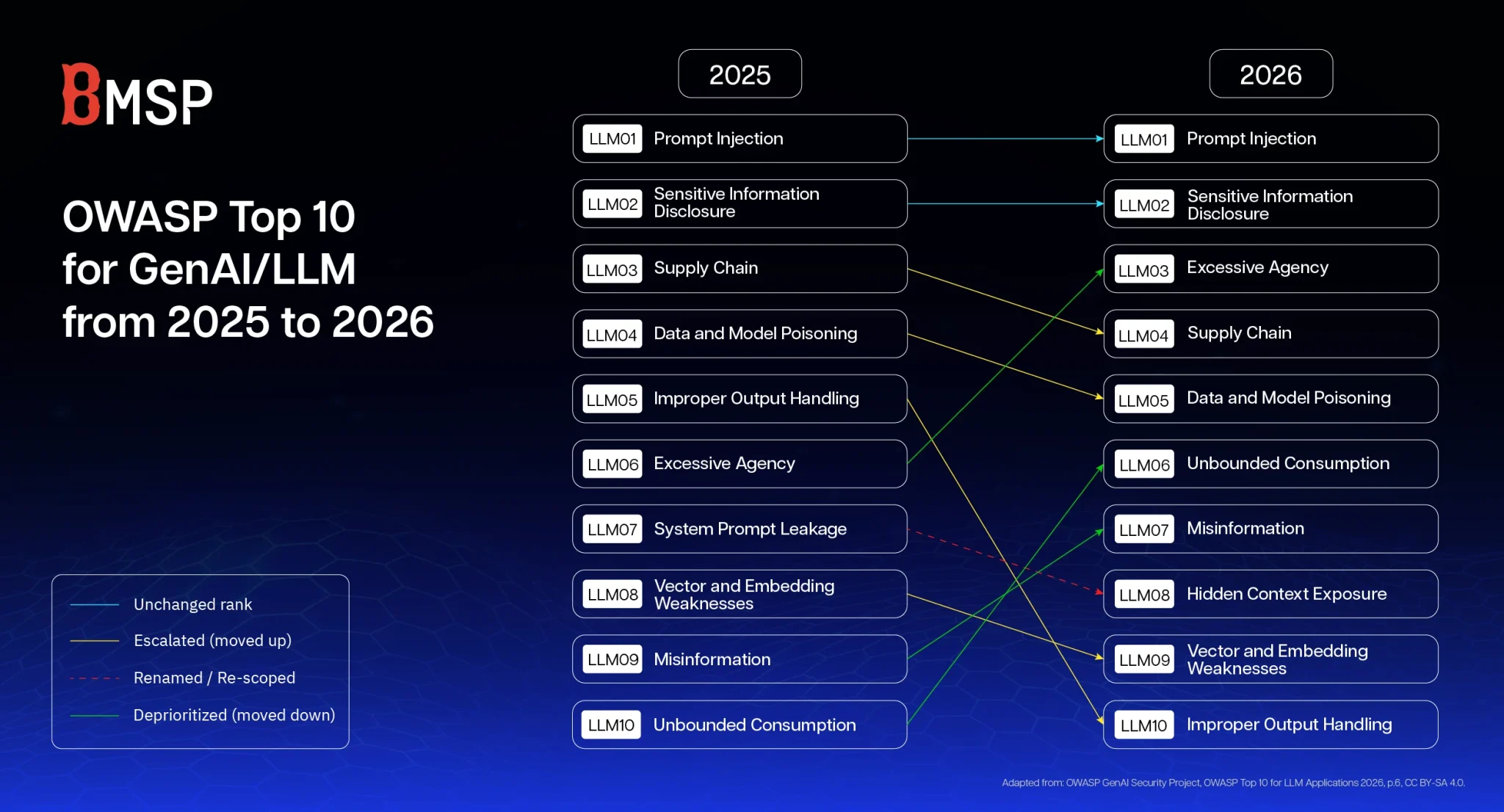
Changes in the OWASP GenAI/LLM Top 10 Ranking from 2025 to 2026
Why Have Some Risks Moved Up or Down in the Ranking?
Excessive Agency moved from number 6 to number 3 because Agentic AI systems are increasingly being adopted. When AI does more than generate responses and can call Tools, access data, send emails, modify files, or perform actions in other systems, errors caused by Hallucination or Prompt Injection can turn into actions with real-world consequences, especially when the AI is granted more Permission or Autonomy than necessary.
Unbounded Consumption moved from number 10 to number 6, highlighting the growing importance of resource and cost controls. This is particularly relevant for Reasoning Models, Multimodal Models, and AI Agents, where a single request can expand into multiple processing steps, consume large numbers of Tokens, or continuously call Tools, potentially resulting in both Denial of Service and Denial of Wallet.
Meanwhile, Improper Output Handling moved from number 5 to number 10, making it the category with the largest decrease in ranking. However, this does not mean that the risk has disappeared. OWASP has also expanded its scope to include insecure code generated by AI.
Another notable change is that System Prompt Leakage has been renamed Hidden Context Exposure to cover a broader range of internal information beyond the System Prompt, including Developer Instructions, Tool Schemas, Internal Policies, Permissions, and Workflow Logic.
Overall, the 2026 changes show that LLM risks are shifting from simply asking what AI can answer toward understanding what AI can do after producing that answer.
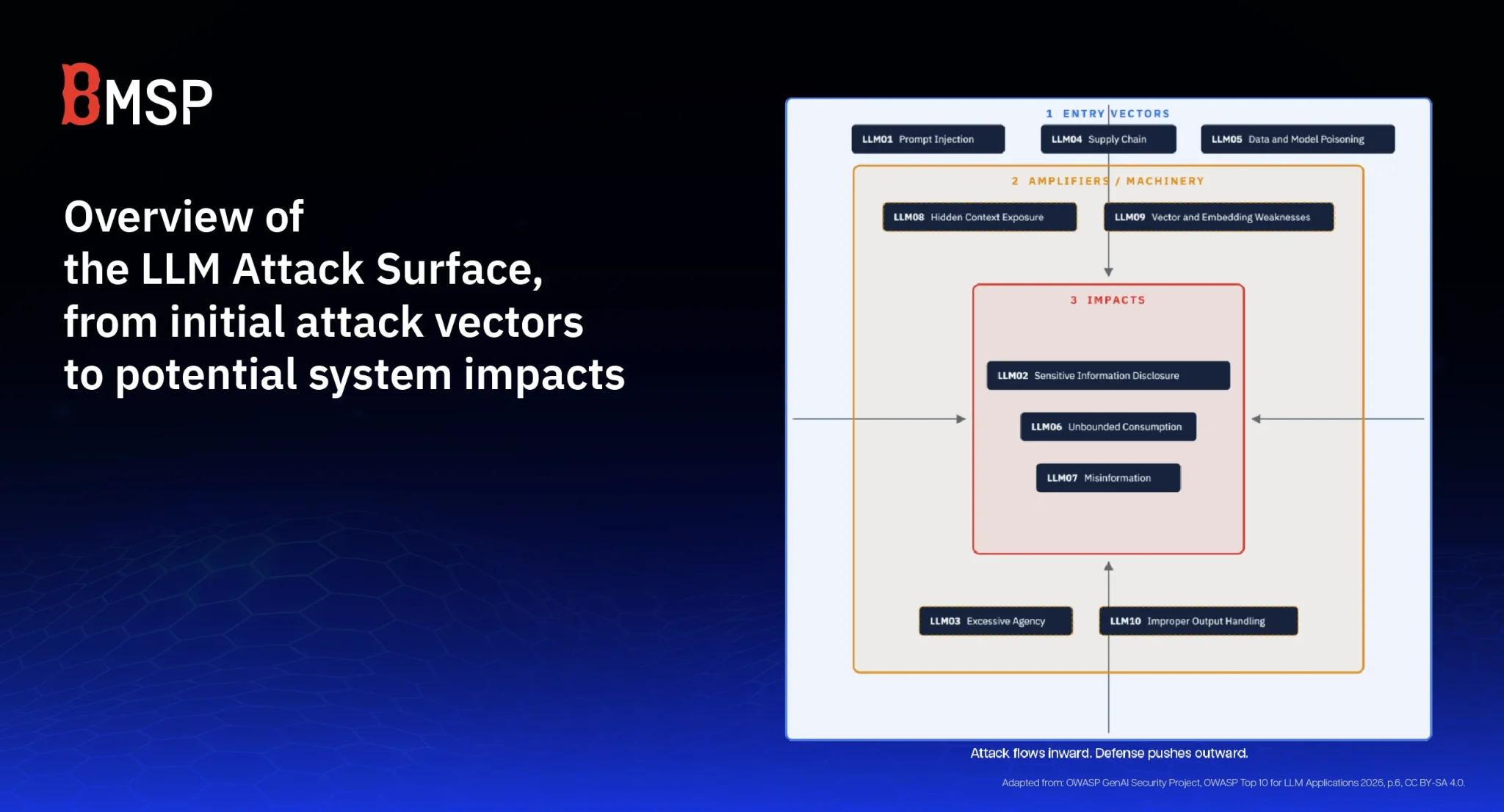
The 10 current risks are not isolated from one another. An attack may begin with Prompt Injection or a Supply Chain compromise, then escalate through excessive privileges, ultimately resulting in data leakage, increased costs, or unintended actions in real-world systems.
10 Major Risks for LLM Applications in 2026
1. LLM01:2026 Prompt Injection
Prompt Injection occurs when information or instructions provided to an LLM cause the model to behave differently from what the developer intended. An attack does not have to originate directly from text entered by a user. Malicious instructions may be hidden in websites, documents, emails, images, audio, videos, Tool Output, RAG data, or Persistent Memory and influence the model without the user ever seeing those instructions.
One of the main reasons for this risk is that LLMs process both Instructions and Data within the same Context without a strict trust boundary separating them. This creates opportunities for information from untrusted sources to influence how the model behaves.
If Prompt Injection succeeds, the impact may range from making the AI respond in a way desired by an attacker and exposing sensitive information to unintentionally calling Tools or performing actions in other systems, especially when the AI is connected to Email, File Systems, Cloud APIs, or internal corporate systems.
What organizations should do: Systems should be designed under the assumption that Prompt Injection may occur. Organizations should therefore not rely solely on Prompt-based protection. AI capabilities and permissions should be restricted according to the principle of Least Privilege, Credentials and permissions for modifying data should be controlled by Application Code, and users should be required to confirm important or irreversible actions.
2. LLM02:2026 Sensitive Information Disclosure
Sensitive Information Disclosure is the risk that an LLM system exposes sensitive or confidential information to unauthorized users, including personal information, financial information, Credentials, API Keys, internal corporate information, or intellectual property.
Information may not leak only through responses displayed by the AI. It can also be exposed through Tool Calls, data retrieved by RAG systems, Logs, Traces, Telemetry, or Embeddings generated during system operation.
Another important area highlighted by OWASP is that Embeddings must also be treated as sensitive data, even though they are represented as numerical vectors. Techniques such as Embedding Inversion may be capable of reconstructing original content from these representations. Therefore, leakage from a Vector Database or Backup containing Embeddings may also result in exposure of the original data.
What organizations should do: Send only the data required by the LLM (Data Minimization), verify user permissions before retrieving information from RAG systems or Vector Databases, enforce Access Control at both Document and Chunk levels, and protect Logs, Traces, Embeddings, and Backups according to the sensitivity of the information they contain.
3. LLM03:2026 Excessive Agency
Excessive Agency is a risk that occurs when an LLM or AI Agent is given more capabilities, permissions, or decision-making autonomy than necessary for its intended function.
For example, an AI designed only to summarize emails should require only permission to “read” messages. However, if the connected Tool can also send or delete emails, those unnecessary capabilities could be misused if the AI is affected by Prompt Injection or performs an unintended action, such as sending sensitive information to an external recipient.
OWASP identifies three major causes of this risk: Excessive Functionality, Excessive Permissions, and Excessive Autonomy. The more critical systems an AI can access, the greater the potential impact.
What organizations should do: Apply the principle of Least Privilege so the AI can access only the Tools and Permissions required for its role. Avoid Tools with unnecessarily broad capabilities and require Human Approval before performing high-impact or irreversible actions.
4. LLM04:2026 Supply Chain
The Supply Chain of an AI system is broader than that of traditional software because it includes not only Libraries and Packages but also Training Data, Models, Adapters, Conversion Pipelines, and Deployment Platforms. Each component can introduce risk, including:
- Model
- Dataset
- LoRA and Adapter
- Model Hub
- Serving Framework
- Model Conversion
- Quantization
- Build and Deployment Pipeline
Risks may arise from using Models or Adapters obtained from untrusted sources or from Artifacts being modified or replaced during storage, Model conversion, or pre-production processes. This could result in an organization unknowingly deploying a Model containing a Backdoor or other undesirable behavior.
OWASP also highlights a risk known as Slopsquatting, which occurs when an AI Coding Assistant recommends a Package name that appears legitimate but does not actually exist. An attacker may register a malicious Package under that name and wait for Developers to install it without verification.
An overview of the Attack Surface across the LLM Supply Chain is shown below.
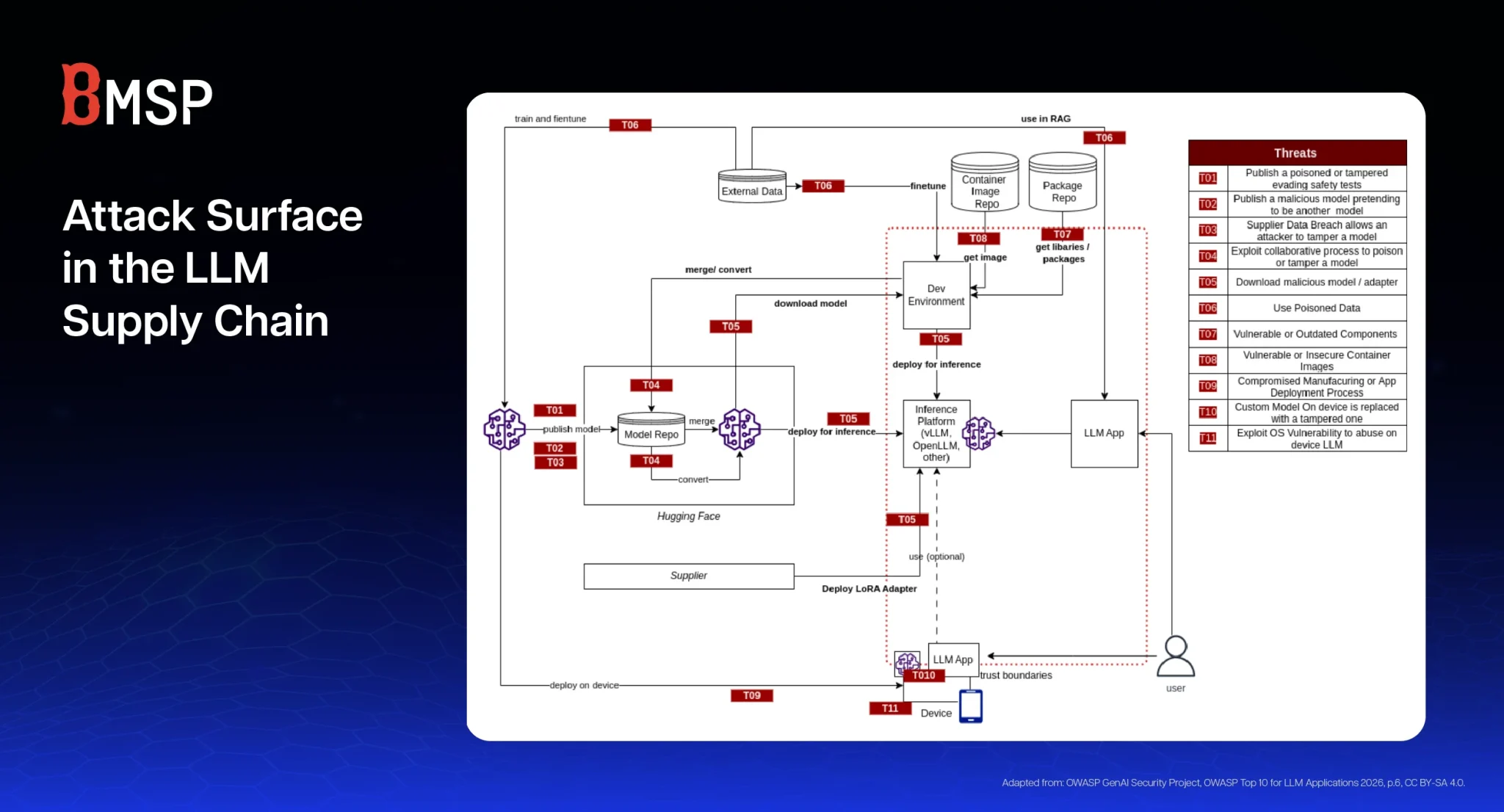
What organizations should do: Verify the origin and Supplier of Models, Datasets, and Components. Maintain an SBOM, AIBOM, or ML-BOM, use Hashes and Digital Signatures to verify Artifacts, and evaluate Model behavior before deployment into Production.
However, Digital Signatures confirm the origin and Integrity of an Artifact but do not guarantee that the Model is secure or free from Backdoors. They should therefore be combined with behavioral testing and Model evaluation before production use.
5. LLM05:2026 Data and Model Poisoning
Data and Model Poisoning occurs when data or Model Artifacts are inserted, modified, or contaminated in ways that cause an AI system to learn or behave incorrectly, potentially introducing Bias, Backdoors, or vulnerabilities that can be exploited.
This risk may occur throughout multiple stages of an AI system, including Pre-training, Fine-tuning, Embedding generation, RAG, Model Distribution, Continuous Learning, and Feedback Loops. It may result either from deliberate attacks or inappropriate data management.
One reason Poisoning is particularly concerning is that the system may continue to appear normal while containing a hidden Backdoor or Trigger that changes its behavior only under specific conditions. As a result, standard testing may fail to identify the issue.
What organizations should do: Maintain the history and origin of Datasets and Models (Lineage), validate information before ingestion, implement Version Control, separate Trusted and Untrusted Data, and continuously test Models for hidden Triggers or Backdoors.
6. LLM06:2026 Unbounded Consumption
Unbounded Consumption is a risk that occurs when an LLM system does not sufficiently control resource usage, allowing requests or Workflows to consume excessive amounts of Tokens, Compute, Memory, or Tool Calls, potentially affecting both system availability and organizational costs.
The risk becomes more significant with Reasoning Models, Multimodal Models, and AI Agents because a single request may trigger multiple rounds of processing, use large Context windows, or continuously and recursively call Tools, rapidly increasing resource consumption.
The impact may include Denial of Service (DoS), making systems slow or unavailable, and Denial of Wallet (DoW), where Cloud or AI service costs increase beyond control. OWASP also includes the risk of submitting large numbers of Queries to perform Model Extraction or create imitation models.
What organizations should do: Controls should not be limited to the number of Requests. Organizations should also implement Token Limits, Spending Caps, Step Limits, Recursion Limits, and Time Limits, together with Circuit Breakers to stop Agent Workflows that loop continuously or consume abnormal amounts of resources.
7. LLM07:2026 Misinformation
Misinformation is the risk that an LLM generates information that is incorrect, incomplete, unsupported by evidence, or misleading, while presenting it in a convincing manner. The risk becomes significant when users or other systems rely on that information to make decisions or perform further actions. Examples include incorrectly interpreting a Policy, recommending a Package that does not exist, summarizing information while omitting important details, or reporting that a task has been completed when no action was actually performed. These situations may lead to financial, Security, or operational damage.
What organizations should do: Apply the Claim–Check–Act concept by separating response generation from execution. Verify information against trusted sources and the actual state of the system before acting on it. Model confidence alone should never be treated as evidence that information is correct.
8. LLM08:2026 Hidden Context Exposure
Hidden Context Exposure is the risk that internal information not intended to be visible to users is disclosed, inferred, or reconstructed through interactions with an LLM.
In 2026, OWASP renamed System Prompt Leakage to Hidden Context Exposure to expand its scope beyond System Prompts to include internal information such as:
- System Prompt
- Developer Instructions
- Tool and Function Schema
- Internal Policy
- User Role and Permission
- Workflow Logic
- Refusal and Filtering Rules
This information may help attackers understand the architecture, behavior, and restrictions of a system and use that knowledge to plan Prompt Injection or subsequent attacks.
A key OWASP principle is that systems should be designed under the assumption that anything placed within the LLM Context may eventually be discovered or exposed. Therefore, system security should not depend solely on keeping this Context secret.
What organizations should do: Do not place Passwords, API Keys, Tokens, or Connection Strings in the Context. System Prompts should also not be used as the primary mechanism for enforcing permissions or Security Policies. Instead, Authorization and Access Control should be enforced by external systems that can be explicitly controlled and audited.
9. LLM09:2026 Vector and Embedding Weaknesses
Vector and Embedding Weaknesses are risks found in systems that convert text, images, code, or audio into Embeddings and use Similarity Search to identify relevant information before passing it to an LLM. RAG (Retrieval-Augmented Generation) is one of the most common examples.
If Embedding storage and retrieval processes are poorly designed, risks may include Cross-Tenant Leakage, Embedding Inversion, Retrieval Poisoning, Retrieval Jamming, Membership Inference, and Semantic Cache Poisoning, which can result in data leakage, manipulated information, or malfunctioning retrieval systems.
For example, in a multi-Tenant system using a Shared Vector Index, if Similarity Search is performed across all data before permissions are checked, an attacker may use the number of returned results, similarity scores, or response timing to infer whether another Tenant’s information exists, as well as its approximate topic or volume, even without directly viewing the document.
Another significant risk is Embedding Inversion, which may allow leaked Embeddings to be used to reconstruct original content. Therefore, Vector Databases and Backups containing Embeddings should be protected at the same level as the original information.
What organizations should do: Enforce Tenant Scope and Permissions during the Retrieval process rather than filtering results afterward. Apply Access Control at the Chunk level, separate Indexes according to Tenant or data sensitivity, and protect Vector Databases and Backups using appropriate encryption, access controls, and Monitoring.
10. LLM10:2026 Improper Output Handling
Improper Output Handling is the risk that output generated by an LLM is passed to another system without proper validation, filtering, or handling. This may include passing AI output to a Browser, SQL Database, Shell, File System, Email, IDE, or API.
If the receiving system directly processes or Executes AI-generated Output, it may introduce vulnerabilities such as XSS, SQL Injection, Path Traversal, Remote Code Execution, or Data Exfiltration. For example, an AI may generate an SQL Query that the application immediately executes, or generate JavaScript/Markdown that is rendered by a Browser without proper filtering.
The key principle is that Output generated by an LLM should be treated as Untrusted Input and validated before being passed to another system. Even if the Output conforms to the expected Schema, this does not mean that the content itself is safe.
Key Summary
The OWASP Top 10 for LLM Applications 2026 demonstrates that much of the potential damage occurs when AI is connected to organizational data, permissions, Tools, and real-world systems.
Organizations should therefore prepare Security Controls that cover Identity & Access Management, Data Protection, Application Security, Supply Chain, Monitoring, Incident Response, and Cost Control.
Organizations do not need to stop using AI simply because risks exist. However, they should clearly understand what the AI can access, what it is allowed to do, and which Security Controls are in place to limit the impact if the model behaves incorrectly.
How Ready Is Your Organization for AI Security?
If your organization is beginning to connect Generative AI, RAG, Copilot, or AI Agents to internal data and systems, now is the right time to assess whether your existing Security Controls adequately cover AI Workflows.
BMSP provides End-to-End Cybersecurity and IT Managed Services through Fully Cloud-Based and Subscription-Based Models, covering AI Security, Identity & Access Security, Data Security, WAF & API Security, Cloud Security, Vulnerability Management, and CSOC 24/7
Talk to the BMSP team to review your organization’s Cybersecurity Readiness and establish an approach to reducing risks before connecting AI to critical business systems.
References