
 ไทย
ไทย English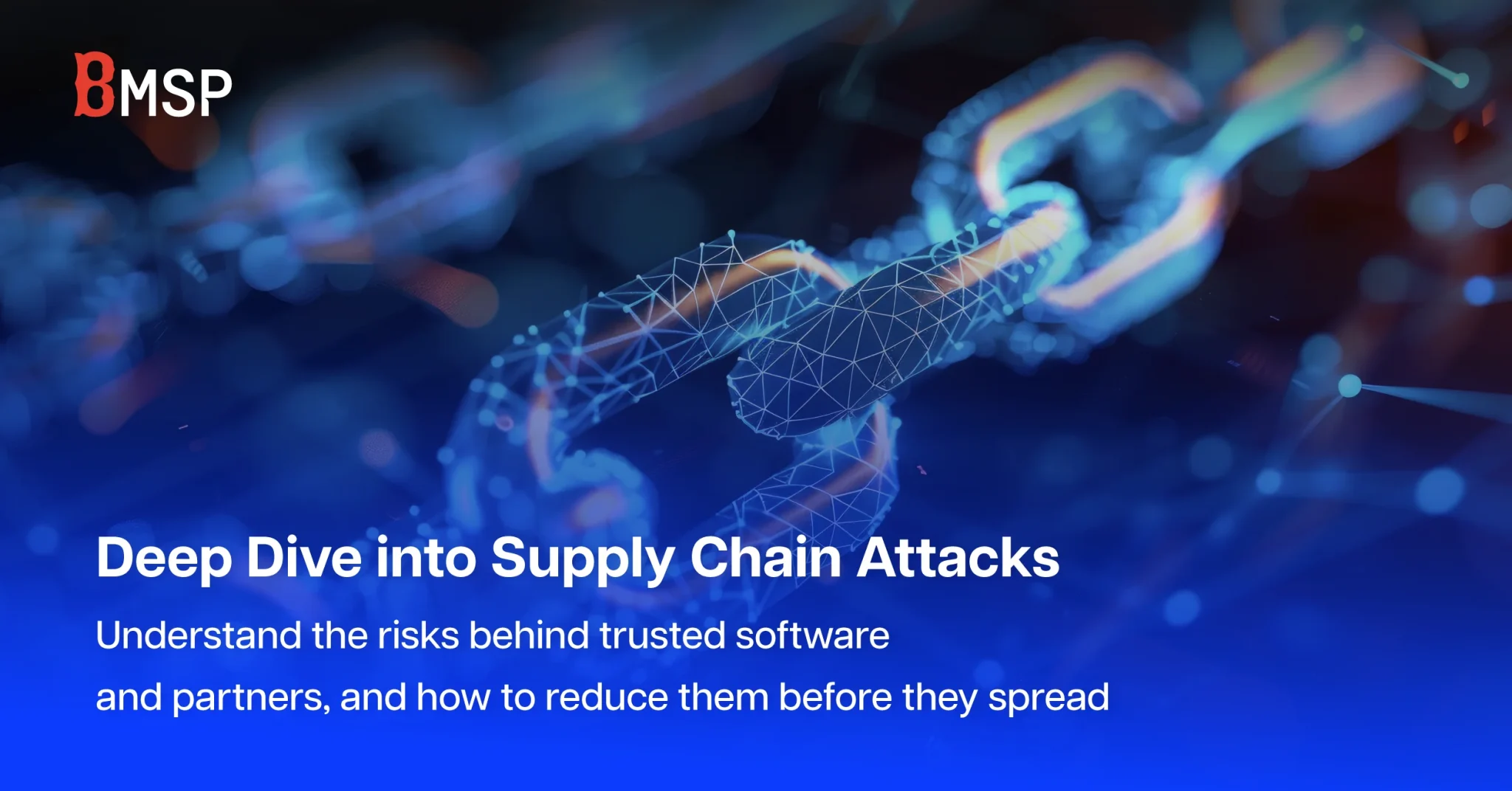

Supply Chain Attack has become one of the cyberattack methods that organizations are seeing more frequently. This type of attack can cause widespread damage, from the theft of secrets, API keys, critical corporate data, and customer information to unauthorized control over cloud systems and enterprise networks.
In this article, BMSP takes a closer look at what a Supply Chain Attack is, how attackers carry out this type of attack, the potential impacts on organizations, and practical ways to prevent and reduce the risks.
Table of Contents
What is a Supply Chain Attack?
A Supply Chain Attack is a cyberattack that targets an organization through an intermediary or a related part of its supply chain, rather than attacking the target organization directly. Attackers exploit weaknesses in third parties such as vendors, partners, outsourcing providers, Managed Service Providers (MSPs), software providers, developers, software update systems, or libraries and open-source packages used by the organization in order to infiltrate systems or create impact.
Attackers often take advantage of the trust that organizations already place in their service providers or systems. By compromising these trusted channels, attackers can introduce threats through services, software, or updates delivered to users. Once a vulnerability or malicious code spreads into an organization, it may lead to malware installation, data theft, or unauthorized access to internal systems, often before users or IT and security teams notice anything unusual in the early stages.
Types of Supply Chain Attacks
1. Software Supply Chain Attack
This type of attack involves compromising software, update systems, build and release processes, or code repositories of software providers. Attackers then insert malicious code into software that customers later use. This risk is directly related to the software development and delivery process. CISA and NIST recommend using C-SCRM and SSDF practices to help reduce this type of risk.
2. Third-party Vendor Attack
A Third-party Vendor Attack occurs when attackers compromise a vendor or partner that has access to an organization’s systems, such as cloud providers, network providers, IT support providers, outsourcing teams, or external administrators. NIST SP 800-161 Rev.1 recommends that organizations manage cybersecurity supply chain risk at every level, including developing policies, plans, and risk assessments for products and services used by the organization.
3. Open-source Package Attack
This type of attack occurs when attackers hide malicious code or vulnerabilities in libraries, dependencies, plugins, or packages that developers use. OWASP explains that software is not developed in isolation, but is part of a software supply chain that includes multiple processes and components, such as software artifacts, dependencies, quality checks, and policy conformance.
4. Managed Service Provider Attack
A Managed Service Provider Attack occurs when attackers compromise a provider that manages systems for multiple customers, such as an MSP, MSSP, or remote management service provider. If the attack succeeds, the compromised provider can become a pathway into the systems of many customer organizations at the same time. ENISA highlights the Kaseya case as an example that demonstrates the need to pay greater attention to Supply Chain Attacks involving Managed Service Providers.
5. Hardware/Firmware Supply Chain Attack
This type of attack involves risks at the product, hardware, firmware, or network device level. NIST SP 800-161 Rev.1 covers cybersecurity supply chain risk management for both products and services, not only software.
How Supply Chain Attacks Work
Supply Chain Attacks often begin with attackers identifying which systems, software, or service providers the target organization uses. They then choose the weakest or most promising entry point, such as a vendor with insufficient security controls, a software provider with many customers, or an open-source package with a large user base.
Once attackers compromise a service provider or interfere with the software development process, they may insert malicious code into software, update systems, packages, or artifacts that are later delivered to customers. OWASP notes that the software supply chain consists of many components, from code and dependencies to artifacts, verification processes, and software delivery. This means that each stage of the process can become a risk if it is not properly controlled.
When the target organization installs software, updates a system, or connects to a trusted provider as usual, attackers can use that trusted channel to enter the internal environment. From there, they may steal data, create hidden accounts, install backdoors, escalate privileges, or move laterally to other systems. This can lead to data breaches, service disruption, or follow-on attacks such as ransomware.
ENISA states that Supply Chain Attacks are increasing and becoming more complex. In the cases studied, many attackers targeted supplier code in order to compromise downstream customers. Many incidents also aimed to access data such as customer information, personal data, or intellectual property.
Examples of Past Supply Chain Attacks
References include CISA information on the SolarWinds Orion Supply Chain Compromise and the joint CISA-FBI guidance on the Kaseya VSA Supply-chain Ransomware Attack.
SolarWinds Orion Supply Chain Attack
One of the most well-known Supply Chain Attacks is the SolarWinds Orion incident in 2020. Attackers were able to insert malicious code into SolarWinds’ Orion Platform, a tool widely used by organizations to manage IT systems. When customer organizations downloaded or installed the compromised update, attackers were able to use that channel as a pathway into downstream organizations.
This incident demonstrates how an attack through trusted software can create broad impact. According to CISA, the incident affected networks belonging to government agencies, critical infrastructure organizations, and private sector companies. It also involved software supply chain compromise and the abuse of widely used authentication mechanisms.
Kaseya VSA Supply Chain Ransomware Attack
Another major case was the Kaseya VSA incident in July 2021. Attackers exploited a vulnerability in Kaseya VSA, software used by Managed Service Providers to manage and support the systems of multiple customers. The attackers then used that channel to distribute ransomware to MSPs and their downstream customer organizations.
CISA and the FBI described the incident as a supply-chain ransomware attack that exploited Kaseya VSA to target multiple Managed Service Providers and their customers. Information from U.S. security agencies also indicated that attackers used a fake update to spread malware from Kaseya VSA through MSPs to downstream organizations. This incident shows how compromising a service provider that manages multiple customers can rapidly expand the impact across many organizations.
Industries Commonly Targeted by Supply Chain Attacks
Supply Chain Attacks can affect almost any industry, especially organizations that are connected to multiple vendors, partners, cloud providers, external software, or third-party systems. The more connection points an organization has, the more opportunities attackers have to use those channels as pathways into core systems.
Manufacturing and industrial organizations are among the higher-risk groups because they involve IT systems, OT systems, machinery, contractors, suppliers, and production management systems that are interconnected across many areas. If a vendor is compromised, the impact may immediately affect production lines, product delivery, or business continuity.
Technology companies, software providers, and cloud service providers are also major targets because they serve as central connection points for many customers. Attackers may attempt to insert malicious code into software, open-source libraries, plugins, extensions, CI/CD pipelines, or software update systems in order to spread the impact to many downstream organizations at once.
Financial services, banking, and FinTech are also high-risk targets because they involve financial data, customer information, transaction systems, APIs, and identity verification systems. Instead of attacking a bank directly, attackers may compromise an external provider such as a payment gateway, KYC provider, CRM platform, core banking support provider, or cloud provider connected to critical systems.
For healthcare organizations and hospitals, risks often come from reliance on many types of external systems, such as electronic medical record systems, medical devices, appointment systems, health insurance systems, and specialized healthcare software providers. If a vendor system is compromised, it may affect patient data, continuity of care, and organizational trust.
Retail, e-commerce, and logistics companies are also frequent targets because they connect with payment systems, warehouses, transportation systems, marketplaces, marketing platforms, and customer management systems. Attackers may use these channels to steal customer data, order information, card data, or insert malicious code into websites and back-end systems.
Energy, utilities, and critical infrastructure are also very high-risk sectors because they involve essential services such as electricity, water, gas, telecommunications, and other critical infrastructure. If an attack occurs through a supplier or externally connected system, the impact may not be limited to one organization. It could affect citizens, businesses, and public services on a wider scale.
In summary, the industries most commonly targeted by Supply Chain Attacks are those that hold critical data, maintain many third-party connections, or play an important role in business operations and public services. Attackers understand that compromising a single supplier or service provider may open the door to multiple target organizations at once.
Impacts of Supply Chain Attacks
Supply Chain Attacks can create both technical and business-level impacts because they exploit channels that organizations already trust. Potential impacts include:
- Leakage of critical corporate, customer, or employee data
- Unauthorized access to internal systems
- Spread of malware or ransomware
- Disruption of critical business systems
- Loss of organizational trust and reputation
- Costs related to system recovery, incident investigation, and security improvement
- Potential impact on compliance, privacy, and data protection requirements
ENISA notes that Supply Chain Attacks can create wide-reaching impact because compromising a single supplier can affect multiple downstream organizations. Its report highlights SolarWinds as an example of a ripple effect that impacted government agencies and many large organizations.
How to Prevent and Reduce Supply Chain Attack Risks
Preventing Supply Chain Attacks requires organizations to view security across both internal systems and the third parties involved. It is not enough to focus only on endpoint or internal network protection. Key approaches include the following:
1. Assess Vendor and Partner Risk
Organizations should assess the security controls of service providers before engagement and review them regularly. This may include reviewing security policies, access management, incident response capabilities, and relevant standards. NIST SP 800-161 Rev.1 recommends that organizations establish a C-SCRM strategy, policy, plan, and risk assessment process for products and services related to the supply chain.
2. Apply Least Privilege Access
Organizations should use solutions that help manage identity and access, such as IAM, PAM, or ZTNA, to ensure that vendors, partners, and external systems receive only the access they need. Organizations should also enforce multi-factor authentication, monitor abnormal behavior, and log user activity. These practices help reduce the risk of compromised accounts being used for attacks or lateral movement inside the organization.
3. Use Multi-Factor Authentication
Accounts that access critical systems, especially remote access, administrator accounts, cloud consoles, and third-party systems, should be protected with MFA. This helps reduce the risk of stolen passwords or credentials being used without authorization.
4. Verify Software Updates and Packages
Organizations should track the sources of software, verify the reliability of packages, and properly control build and release processes. For systems that rely on many software components, OWASP recommends using SBOM and dependency graphs to provide visibility into software components and dependency relationships. These tools can help organizations manage vulnerabilities, check compliance, and respond to incidents more quickly.
5. Monitor Logs and Abnormal Behavior
Organizations should use monitoring, SIEM, or SOC/CSOC capabilities to detect abnormal behavior, such as logins from unfamiliar locations, access to large volumes of data, creation of new accounts, or unusual connections from third parties. Continuous monitoring helps organizations detect anomalies involving service providers or externally connected systems more quickly.
6. Segment Networks and Control Connections
Organizations should segment critical systems and control access paths from vendors or external systems. This prevents attackers from easily moving to other systems if a vendor account or external connection is compromised. Limiting access paths can help reduce the scope of impact.
7. Create an Incident Response Plan for Third-party Risk
Incident response plans should include scenarios where vendors or partners are compromised. This may include procedures for disconnecting access, rotating credentials, reviewing historical logs, and communicating with relevant stakeholders. CISA and NIST recommend that both software producers and software users establish systematic approaches to identify, assess, and reduce software supply chain risks.
8. Review Security Clauses in Contracts and SLAs
Organizations should define security requirements in contracts with service providers, such as incident notification timelines, compliance with security standards, audit rights during incidents, and data protection requirements. This helps organizations manage third-party risk more clearly. This approach aligns with C-SCRM principles, which emphasize the continuous management of risks related to products, services, and parties involved in the supply chain.
Key Takeaways
Supply Chain Attack is a cyber threat that exploits the connections between an organization and external service providers, including vendors, partners, software providers, Managed Service Providers, open-source packages, and trusted systems. Attackers use these trusted relationships as channels to infiltrate systems, steal data, deploy malware, or expand attacks to downstream organizations. Because a single compromised connection can affect many organizations at once, this type of attack can cause widespread damage.
Reducing the risk of Supply Chain Attacks requires continuous security management, from vendor risk assessment and access control to software and dependency verification, abnormal behavior monitoring, and incident response planning that covers third-party risk. These measures help organizations detect threats, limit impact, and respond in a timely manner.
In addition to internal security measures, choosing a service provider with strong security standards is an important factor in reducing Supply Chain Attack risks. BMSP is ready to help organizations strengthen cybersecurity in a systematic way, supported by ISO/IEC 27001 standards, an experienced cybersecurity team, and robust security practices. Our services cover prevention, monitoring, threat detection, and continuous risk management, helping organizations reduce risks from Supply Chain Attacks and Third-party Risk with confidence.
References
- CISA & NIST: Defending Against Software Supply Chain Attacks
https://www.cisa.gov/sites/default/files/publications/defending_against_software_supply_chain_attacks_508.pdf
- NIST SP 800-161 Rev.1: Cybersecurity Supply Chain Risk Management Practices for Systems and Organizations
https://csrc.nist.gov/pubs/sp/800/161/r1/upd1/final
- OWASP: Software Supply Chain Security Cheat Sheet
https://cheatsheetseries.owasp.org/cheatsheets/Software_Supply_Chain_Security_Cheat_Sheet.html
- OWASP: Dependency Graph & SBOM Best Practices Cheat Sheet
https://cheatsheetseries.owasp.org/cheatsheets/Dependency_Graph_SBOM_Cheat_Sheet.html
- ENISA: Threat Landscape for Supply Chain Attacks
https://www.enisa.europa.eu/sites/default/files/publications/ENISA%20Threat%20Landscape%20for%20Supply%20Chain%20Attacks.pdf