
 ไทย
ไทย English

Today, organizations are increasingly using Cloud, SaaS, API, Remote Work, and systems connected to Third-party services. As a result, the number of digital assets and connection points continues to grow, and each of these points may become a channel that attackers can use to access systems or sensitive information.
Understanding the concept of an Attack Surface is important for organizations to identify which areas may be exposed to Cyberattack risks and to plan appropriate measures to monitor, protect, and reduce those risks.
Table of Contents
What is an Attack Surface?
An Attack Surface refers to all points, channels, or components within a system and organization that malicious actors (Hackers or Threat Actors) may use as a means to attack, access systems, steal information, or cause damage to the organization.
An Attack Surface can exist across many areas, such as Websites, Web Applications, APIs, Servers, Cloud environments, Networks, Endpoints, User Accounts, as well as physical devices and personnel within the organization. Each point is not necessarily a vulnerability by itself, but if it is improperly configured, not updated, or lacks sufficient controls, it may become a channel that attackers can exploit. The more assets and connection points an organization has, the larger its Attack Surface becomes and the more areas need to be managed.
How many types of Attack Surface are there?
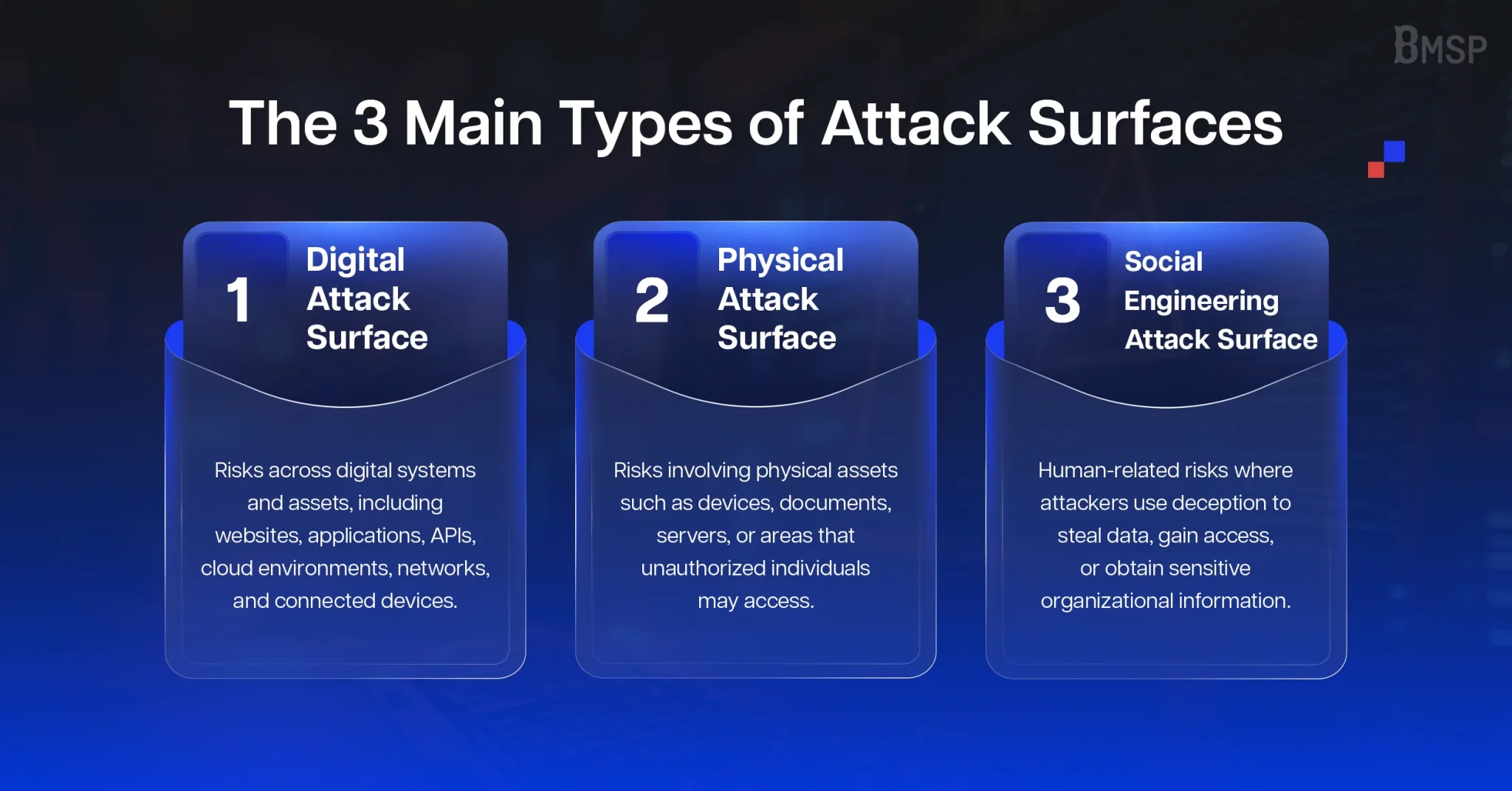
An organization’s Attack Surface is not limited to systems connected to the Internet. It also includes physical devices and personnel within the organization. It can generally be divided into three main types: Digital Attack Surface, Physical Attack Surface, and Social Engineering Attack Surface.
1. Digital Attack Surface
Digital Attack Surface refers to the areas of risk created by systems, technologies, and digital assets that attackers may use as channels to access an organization’s systems or data. Examples include Websites, Web Applications, APIs, Cloud Services, Servers, Networks, Domains, IP Addresses, Endpoints, and connected devices.
Risks may arise from various factors, such as Software vulnerabilities, Misconfiguration, systems that have not been updated, or unnecessary Services that are still enabled. They may also come from Shadow IT or assets created without the Security team’s awareness.
As organizations adopt more connected digital systems and services, the Digital Attack Surface continues to expand. Organizations therefore need visibility into which assets are exposed and which points may become potential channels for attacks.
2. Physical Attack Surface
Physical Attack Surface refers to risk areas related to physical assets, devices, or locations that malicious actors may use to gain access to systems or sensitive information.
Examples include Computers, Laptops, Servers, USB Drives, documents containing sensitive information, storage cabinets, as well as areas such as Server Rooms or offices where access controls may be insufficient.
Risks in this area may occur when devices are lost or stolen, or when unauthorized individuals are able to access important locations or equipment. Examples include connecting an unsafe USB device to an internal computer or accessing a Server without authorization.
Therefore, reducing the Physical Attack Surface does not rely solely on Cybersecurity measures. It also includes physical access controls, secure equipment storage, and appropriate access permissions for sensitive areas.
3. Social Engineering Attack Surface
Social Engineering Attack Surface refers to risk areas related to people, where attackers use deception, persuasion, or manipulated situations to convince victims to disclose sensitive information or perform actions desired by the attacker.
Common examples include Phishing Emails, impersonating executives or IT staff, tricking users into revealing Passwords or OTPs, and sending malicious Links or files for users to open or download.
Even if an organization has strong security systems, technical controls may still be bypassed if users are tricked into revealing Credentials or granting attackers access to systems.
Reducing the Social Engineering Attack Surface should therefore focus on building Security Awareness, training employees, implementing identity verification procedures, and using measures such as Multi-Factor Authentication (MFA) to help reduce the impact if user account information is compromised.
How to identify and assess a system’s Attack Surface
Understanding an Attack Surface begins with identifying where a system can receive data, send data, or connect to external sources, because these points may become channels that attackers can use to access the system.
In practice, organizations can begin by reviewing the system structure, architecture, applications, and data flows to identify system entry and exit points. Examples include Login pages, website forms, APIs, HTTP Headers, Cookies, files, databases, storage systems, and connections to other systems or applications.
Because a single system may have many connection points, grouping the Attack Surface based on usage can make analysis easier, such as:
Login and Authentication points
Admin pages or administrator systems
Data entry and modification forms
Search and data retrieval systems
APIs and data communication channels
Business Workflows or critical business processes
Connections to Third-party services or external systems
In addition to identifying connection points, organizations should also consider what sensitive information each area can access, such as personal data, business information, or data subject to Compliance requirements. An Attack Surface connected to sensitive information may have a greater impact than less critical areas of the system.
Assessing which Attack Surface areas carry higher risk
Once the overall Attack Surface is visible, the next step is to determine which areas are more likely to be targeted, particularly systems exposed to the Internet or accessible by external users.
Examples of areas that should receive particular attention include systems that allow connections through Networks, Web Forms, APIs, externally supplied files, as well as systems related to Authentication, Authorization, Session Management, and Cryptography.
Legacy systems or features that remain enabled can also increase the Attack Surface. Examples include outdated Protocols, unpatched Libraries, unused features, or multiple Software versions installed simultaneously. The more components that remain accessible, the more points need to be monitored and protected.
Another area that is often overlooked is Backup, including both data and Source Code. Even if the main system is well protected, improperly secured Backup systems may provide another channel for attackers to access sensitive organizational data.
Therefore, understanding where a system’s Attack Surface is located and which areas carry higher risk helps organizations identify where to focus their attention and plan appropriate measures to reduce exposure.
Attack Surface vs Attack Vector: What is the difference?
Although Attack Surface and Attack Vector are both related to Cyberattacks, they have clearly different meanings.
Attack Surface refers to all points or areas within a system that attackers may be able to access or target. It focuses on the question: “Where can an attacker attack?” Examples include Websites, APIs, Servers, Cloud environments, Endpoints, or User Accounts. All of these are parts of an organization’s systems or environment that may present opportunities for attacks.
Attack Vector refers to the method, technique, or path chosen by an attacker to access or attack a system. It focuses on the question: “How does the attacker carry out the attack?” Examples include Phishing, Malware, Credential Theft, or exploiting a system vulnerability. An Attack Vector is the method attackers use against an Attack Surface to gain access or cause damage.
For example, if an organization has a Web Application that is accessible through the Internet, the Web Application is considered part of the Attack Surface because it can be accessed by attackers. Discovering and exploiting a vulnerability in the Web Application to gain system access would be considered an Attack Vector because it is the method used to carry out the attack.
Examples of Attack Surface in organizations
An organization’s Attack Surface can come from many areas, including Internet-connected systems, internal devices, Cloud environments, user accounts, and personnel. Common examples include:
Websites and Web Applications accessible by external users
APIs used to connect systems or Third-party services
Servers, Network Devices, and Endpoint devices
Cloud Services and Cloud Resources
Domains, Subdomains, and IP Addresses belonging to the organization
Remote Access services such as VPN or Remote Desktop
Email Accounts and user accounts
Software or systems that have not been updated
Shadow IT or systems used without the awareness of IT or Security teams
Physical devices and information, such as Laptops, USB Drives, and important documents
These components are not necessarily vulnerabilities by themselves. However, if they are improperly configured, contain vulnerabilities, or lack sufficient controls, they may become points that attackers can use to access an organization’s systems or information.
Why does the Attack Surface continue to expand?
An Attack Surface can change and expand as an organization grows and adopts new technologies, particularly when using Cloud, SaaS, APIs, Remote Work, and systems connected to Third-party services.
Adding new Applications, Servers, Domains, or Cloud Resources means that the organization has more assets and connection points to manage. In addition, Configuration changes, temporary system deployments, or the use of Shadow IT may create new Attack Surface areas without the Security team being aware of them.
Another factor is legacy systems that have not been fully decommissioned, such as old Subdomains, unnecessary Services, outdated Software Versions, or inactive user accounts. These may still provide opportunities for attackers to gain access.
Therefore, the more complex and frequently changing an organization’s IT infrastructure becomes, the more challenging it is to maintain visibility across the entire Attack Surface.
How to reduce the Attack Surface
Reducing the Attack Surface aims to decrease the number of points attackers can use to access systems. This does not mean that every system must be shut down, but unnecessary components should be reduced and stronger controls should be applied to higher-risk areas.
Key approaches include:
Disable unnecessary Services and Ports to reduce connection points exposed to external access
Regularly update Software and patch vulnerabilities to reduce risks from known vulnerabilities
Remove or disable unused systems such as old Applications, Accounts, Domains, or Cloud Resources
Apply access permissions based on necessity using the Least Privilege principle to reduce the potential impact if an account is compromised
Use Multi-Factor Authentication (MFA) to strengthen protection for accounts and critical systems
Review system and Cloud Configuration to reduce risks caused by Misconfiguration
Segment Networks to limit access and reduce the ability of attackers to move between systems
Build Security Awareness among employees to help reduce risks from Phishing and Social Engineering
Regularly review the Attack Surface to identify new assets or risk areas created by changes in the environment
Because an Attack Surface can change continuously, reducing it should be an ongoing process. Organizations can use an Attack Surface Management (ASM) approach to continuously discover, monitor, assess, and manage risks associated with the Attack Surface.
- What Is an Attack Surface Management (ASM)?
Continuously manage your Attack Surface with Attack Surface Management from BMSP
Knowing where an organization’s Attack Surface exists is only the beginning. What matters is the ability to continuously identify changes in digital assets, discover exposed points, and assess potential risks.
Attack Surface Management (ASM) from BMSP helps organizations discover and monitor Digital Assets that are connected or exposed externally, while providing Security teams with clearer visibility into the Attack Surface. This includes Domains, Subdomains, IP Addresses, Cloud Resources, and systems that may have been created without the Security team’s awareness.
With more comprehensive Visibility, organizations can identify risk areas, prioritize them, and plan appropriate remediation. This helps reduce the likelihood that an Attack Surface becomes a channel for Threat Actors to access critical systems or sensitive information.
BMSP provides End-to-End Cybersecurity and IT Managed Services to help organizations continuously identify, reduce, and monitor their Attack Surface. Services include Attack Surface Management (ASM), Vulnerability Management,WAF & API Security, Cloud Security, Identity & Access Security, as well as 24/7 CSOC services to help detect and respond to threats that may arise from an organization’s digital systems and assets.
If your organization needs to assess its Attack Surface and develop a structured approach to reducing risk, consult BMSP experts to design a Cybersecurity approach suitable for your organization’s environment.
If your organization needs to assess its Attack Surface and develop a structured approach to reducing risk, consult BMSP experts to design a Cybersecurity approach suitable for your organization’s environment.