
 ไทย
 English
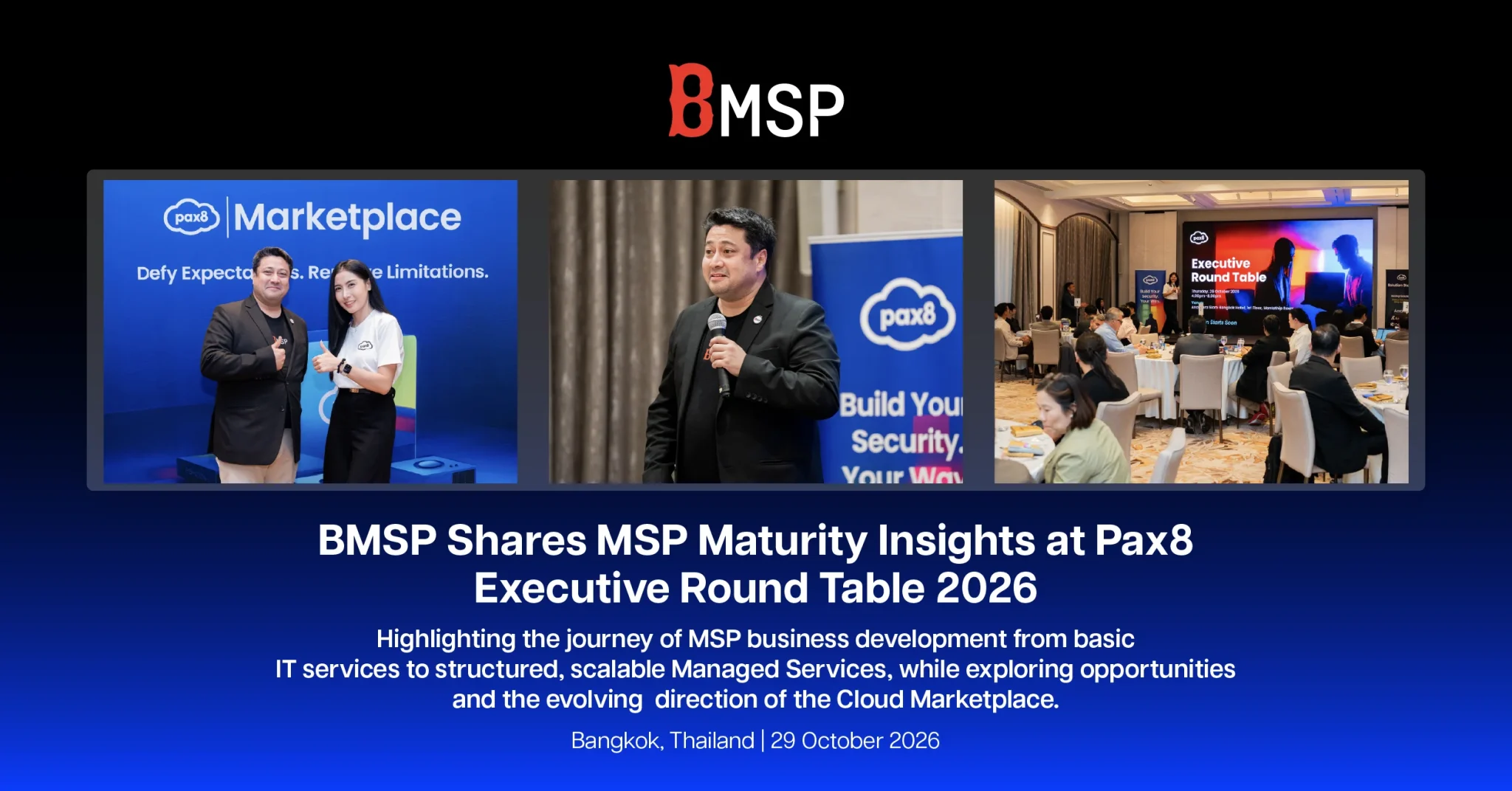

BMSP shared its experience on MSP Maturity Stages while exchanging perspectives with industry leaders on the development of Managed Services businesses and the direction of the Cloud Marketplace.
On October 29, 2026, Kris Nawani, Co Founder and Director of BMSP, was invited by Pax8 Thailand to join the Pax8 Executive Round Table 2026 as a Speaker at Anantara Siam Bangkok Hotel. The event provided an opportunity to share experiences and exchange perspectives with executives and IT service providers on the development of Managed Services businesses and emerging opportunities in the market.
The event was held under the theme “Defy Expectations. Remove Limitations.” and provided a platform for partners and industry leaders to exchange real business experiences, discuss approaches to service development, and explore how service providers can prepare for the evolving direction of the Cloud Marketplace.
BMSP Shares Experience on MSP Maturity Stages
During the Partner Sharing Expertise session, BMSP shared its experience on MSP Maturity Stages, highlighting that the development of a Managed Service Provider is not simply about adding more products or technologies to its Portfolio. It involves progressively strengthening service capabilities, from License sales, Implementation, and Configuration to continuous system management, Monitoring, Detection and Response, and eventually the development of services delivered through Packages or Platforms.
The MSP Stage Maturity Model presented during the session illustrates a journey beginning with Stage 0: License Purchase Only, which primarily focuses on License provisioning. It then progresses to Stage 1: Implementation, Stage 2: Corrective Service, Stage 3: Full Managed Service including MDR, Stage 4: Service Package, and eventually Stage 5: Platform for Service Delivery, where multiple technologies and services are brought together and managed through a more unified service delivery model.
Each Stage therefore represents more than simply offering additional services. It also reflects the development of Service Capability, Process, People, and service delivery models that enable providers to support increasingly complex customer requirements.
Capabilities developed at each Stage build upon those established in previous Stages. Moving toward Managed Services therefore requires the appropriate structure and capabilities rather than simply shifting directly from product sales to a Managed Services model.
For example, a provider may begin with Implementation and Configuration services before progressing toward Health Checks, Policy and Posture Hardening, and Proactive Alerting. From there, the service can evolve further to include continuous Monitoring, Detection, Triage, and Incident Response on a 24/7 basis, which requires more advanced processes and people with the appropriate expertise.
Understanding where an organization or service provider currently sits within its MSP Maturity journey can therefore help identify which areas of Process, People, Technology, or Service Delivery should be developed next to support long term growth.
From IT Service Provider to Strategic Technology Partner
Customer requirements are becoming increasingly complex. Organizations that may once have required only system installation or occasional IT troubleshooting are increasingly looking for services that can continuously manage their environments while reducing the operational workload of internal IT teams.
The MSP Maturity approach also reflects a broader shift from selling individual Technology products toward delivering Services and Outcomes.
At more advanced stages, service providers can combine multiple Technologies and Services into a single Service Package. This can reduce the need for customers to manage individual products and service providers separately. Moving toward a Platform Model can further enable technologies from multiple Vendors to be managed through a more unified service model, creating a more consistent experience for customers.
This evolution is changing the role of the Managed Service Provider from being primarily a technical service provider into a Strategic Technology Partner that needs to understand the customer’s Technology, Operations, and Business Requirements.
For MSPs, service development should therefore not focus only on adding new products to the Portfolio. It is also important to consider how those technologies can be combined into services that create meaningful outcomes for customers, whether the service model is clearly defined, and how effectively it can support the growth of both the service provider and the customer.
Exchanging Experiences Across the IT Service Industry
In addition to BMSP, executives from other IT service providers also shared their experiences on a range of topics, from building an MSP with a small team and developing services that can differentiate a business in a price competitive market to transforming existing internal tools into new service offerings.
The perspectives shared by different service providers demonstrated that there is no single approach to developing a Managed Services business. What matters is understanding the organization’s strengths, customer requirements, and how services can be developed to create sustainable value.
Exchanging experiences in this way allows service providers to see both opportunities and challenges from different perspectives and bring relevant ideas back to their own organizations for further business development.
Managed Services and Growing Business Opportunities
As IT, Cloud, and Cybersecurity environments become increasingly complex, many organizations are looking for specialists who can continuously manage their systems rather than relying only on support when an Incident occurs.
This is increasing the importance of Managed Services across areas such as Infrastructure, Cloud, and Cybersecurity, as well as daily Monitoring and Support.
The MSP Maturity approach also demonstrates how a provider’s capabilities can gradually evolve from implementing and managing Technology toward taking greater responsibility for Security and Operational Outcomes.
This is particularly evident at the Managed Service and MDR stages, where services can include continuous Monitoring, Detection, and Response.
For IT service providers, this trend represents an opportunity to evolve from businesses focused mainly on Product or Project sales toward service models that create longer term customer relationships while helping organizations manage technology more effectively.
BMSP and the Continuous Development of Managed Services
Being invited to participate as a Speaker at the Pax8 Executive Round Table 2026 provided another opportunity for BMSP to share its experience in developing Managed Services while exchanging ideas with partners and other service providers across the industry.
BMSP continues to develop its Cybersecurity and IT Managed Services through an End to End service model designed to help organizations continuously manage their IT and Cybersecurity environments.
Our services cover everything from planning and technology implementation to ongoing Monitoring, Management, and Support delivered by experienced specialists.
The concept of MSP Maturity also reflects how Managed Service Providers can continue evolving from offering individual Technology products toward developing services that bring together Technology, People, and Process to deliver more consistent outcomes and experiences for customers.
For organizations looking for a partner to support their IT, Cloud, or Cybersecurity environments, BMSP can help assess and identify a service model that aligns with your organization’s requirements.