

 ไทย
ไทย English

Summary of Concepts from the NSA
In an era where cyber threats are increasingly sophisticated and constantly evolving, traditional security approaches that rely on trusting internal users or protecting only the network perimeter with firewalls are no longer sufficient.
This is why Zero Trust Architecture (ZTA) has become one of the most important cybersecurity frameworks adopted by organizations worldwide.
This article summarizes key concepts from the “Zero Trust Implementation Guideline – Primer” published by the National Security Agency (NSA) to help organizations better understand Zero Trust and how it can be implemented effectively.
What is Zero Trust?
Zero Trust is a cybersecurity concept built on two fundamental principles:
Never Trust, Always Verify
– No user, device, or system should be trusted automatically.
Assume Breach
– Organizations must assume that a compromise may already exist and design security controls accordingly.
Every access request to systems, data, or applications must be verified, authenticated, and authorized appropriately, regardless of whether the request originates from inside or outside the organization.
Why Zero Trust is Important
The United States Government established Zero Trust as a national cybersecurity strategy through Executive Order 14028, after recognizing that modern cyberattacks can easily bypass traditional security defenses.
Common attack vectors include:
- Credential Theft
- Ransomware
- Supply Chain Attacks
- Insider Threats
Zero Trust is designed to reduce risk at the source and limit the impact of attacks when breaches occur.
| Zero Trust is Not Just Technology — It is a Mindset
Zero Trust is not simply about purchasing new security technologies
According to the National Security Agency (NSA), Zero Trust is a fundamental shift in how organizations design and manage security, affecting policies, operational processes, and technology architecture.
Zero Trust assumes that no user, device, or system should be inherently trusted, whether located inside or outside the organization’s network. Every access request must always be verified.
To support this model, organizations must develop several key capabilities.
First, organizations must continuously evaluate every access request, not only during the initial login but throughout the entire session. Access decisions should be re-evaluated based on the context and security posture of the request.
Second, organizations must validate the security posture of devices. Devices accessing corporate resources must meet defined security policies such as updated patches, malware protection, and secure configurations. If a device fails to meet these standards, access must be restricted or denied.
Organizations must also prioritize logging and behavioral analysis to achieve comprehensive system visibility. Logs and behavioral analytics enable organizations to detect anomalies, suspicious activities, and potential threats early.
Finally, organizations must be prepared to respond and recover from incidents effectively. Zero Trust acknowledges that breaches may occur, making incident response capabilities and recovery plans essential for minimizing damage and maintaining business continuity.
Designing a Zero Trust Architecture
An effective Zero Trust architecture should begin with the following steps:
- Identify the organization’s most critical assets (Crown Jewels)
- Design security controls from the inside out
- Apply the Least Privilege principle, granting only necessary access rights
- Monitor and log all traffic and activities across the environment
- Use contextual signals such as user identity, device posture, location, and behavioral patterns
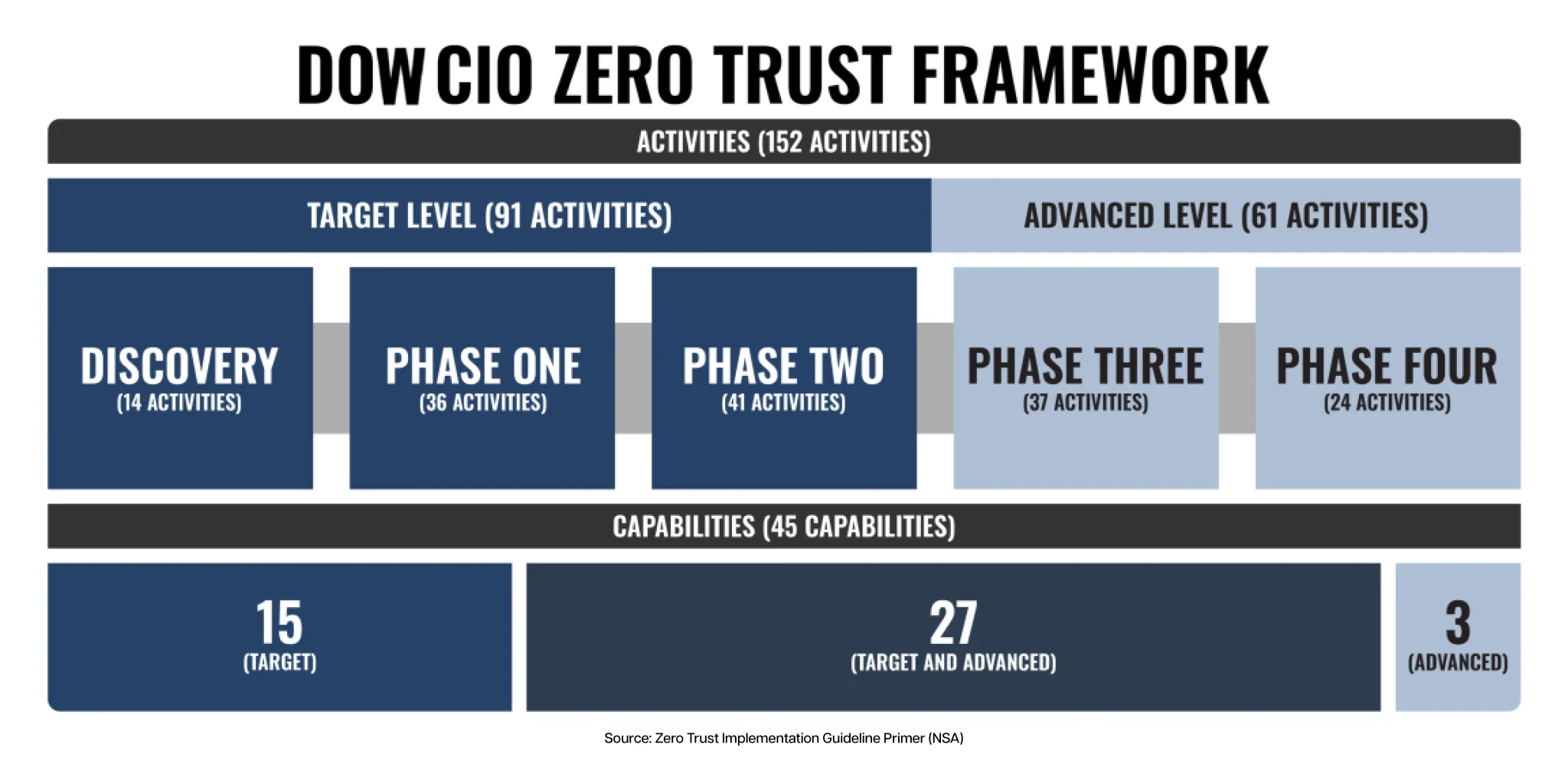
Implementing Zero Trust in Phases
The NSA recommends implementing Zero Trust gradually rather than attempting full deployment at once.
Implementation typically includes:
- Discovery Phase
Identify users, devices, applications, and data across the organization. - Phase One
Establish foundational capabilities including Identity management, device validation, and access control. - Phase Two
Begin integrating full Zero Trust security solutions and enforcement mechanisms.
More advanced phases can be developed over time as the organization matures its security posture.
This phased approach allows organizations to begin with what they already have and gradually improve their cybersecurity capabilities.
The 7 Pillars of Zero Trust
The Zero Trust framework is structured around seven core pillars designed to support modern IT environments. These pillars align with the DoD Zero Trust Framework and emphasize the following principles:
- Continuous Verification
- Identity and Context Validation
- Strict Access Control
- Comprehensive Data Protection
These pillars work together to strengthen the overall security posture of an organization.
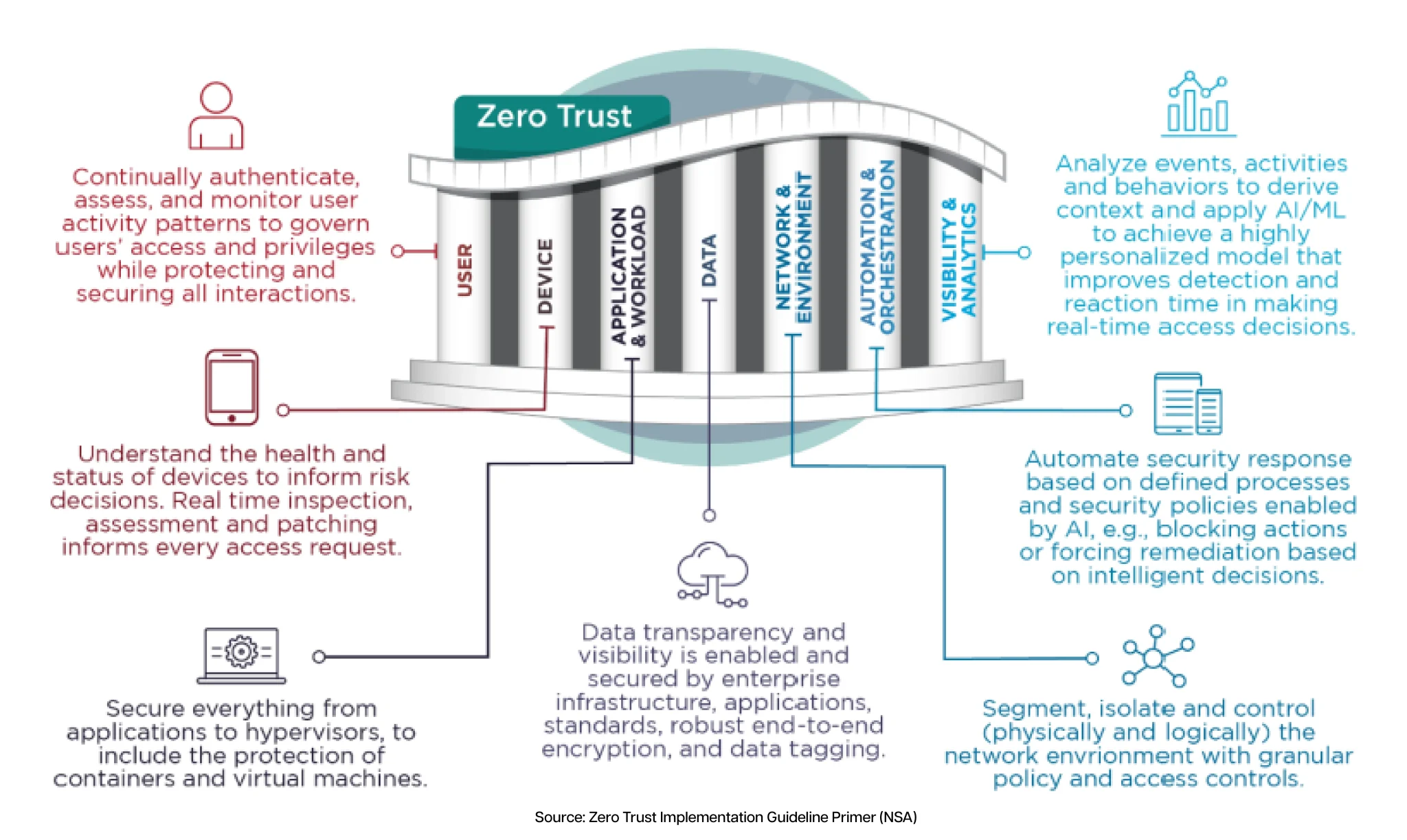
Core Components of Zero Trust
- User
User identities must be continuously authenticated, risk-assessed, and monitored.
Privileges and access rights should be dynamically adjusted based on context and behavior to ensure secure interactions - Device
The security posture of every device must be validated before access is granted. This includes verifying patch status, malware protection, and device security configurations.
This validation should be performed in real time for every access request. - Application & Workload
All system components must be protected, including applications, workloads, infrastructure services, containers, virtual machines, and hypervisors.
No system component should be automatically trusted, even within internal networks. - Data
Organizations must maintain visibility and protection of data through security controls such as:
– End-to-end encryption
– Access policies
– Data classification and labeling
These mechanisms ensure that data is accessed and used securely. - Network & Environment
Networks should be segmented and controlled using both physical and logical security boundaries. Granular access policies help prevent attackers from moving laterally within the network environment. - Automation & Orchestration
Automation and AI-driven security responses allow organizations to enforce security policies efficiently.
Examples include automatically blocking suspicious access requests or enforcing remediation actions.
Automation significantly reduces response time and minimizes human error. - Visibility & Analytics
Organizations must collect and analyze telemetry, events, and behavioral data across the entire environment.
Using AI and machine learning, organizations can detect threats more accurately and make real-time access decisions.
Although Zero Trust Architecture provides a powerful security framework, implementing it within an organization can be challenging. It often requires adjustments to policies, operational processes, and technology environments.
A practical starting point is conducting a Zero Trust Readiness Assessment, identifying critical assets (Crown Jewels), analyzing users, devices, applications, and access patterns, and then developing a phased implementation roadmap.
Organizations can begin by strengthening core areas such as:
- Identity management
- Device security
- Access control
- System visibility and monitoring
BMSP provides cybersecurity expertise to help organizations assess their readiness for Zero Trust adoption, design appropriate security architectures, and develop implementation roadmaps aligned with their business environment.
Our cybersecurity specialists support organizations in strengthening security posture and reducing cyber risk through effective Zero Trust strategies.
If your organization would like guidance on how to begin implementing Zero Trust, please contact BMSP for consultation at marketing@bangkokmsp.com